fredag, september 07, 2007

Luciano Pavarotti dead


Most of us now know that the great tenor is dead and this did not come as a surprise if one knew what kind of disease he was suffering from.

I have only heard him live once in my life, in Stockholm, at the Stocholm Globe Arena. It was in 1992 and he sang in a setting-up of Guiseppe Verdi's 'Requiem'.

The Russian conductor, Vladimir Fedoseyev lead the Norwegian Radio Orchestra, Kringkastingsorkestret from Oslo and the World Festival Choir with 1800 singers! 

The other soloists were the magnificent singers Carol Vaness, Shirley Verrett and Franco de Grandis.

I remember being somewhat sceptical towards the acoustic conditons in the Globe Arena but when it came to the soloists, it functioned well. 
The choir however did not always sound well, but not because of them but because of the fact that there where "too many" singers in the choir and this became hard to moderate from an acoustical point of view.

Many critics say that Pavarotti should have ended his singing career earlier. 
This is probably right from an artistic point of view. On the other hand, if people still want to pay money in order to listen to an artist even if he is not at the peak of his career, who can blame him for continuing?
It's true that he reached his peak as a singer many, many years ago. He managed though to keep his voice in good shape even at this fairly high age for a singer. 
It is also hard for an artist to end his career and stop singing publically when - like in this case - his instrument always is within him.

One can always discuss if Pavarotti promoted opera as an art form or only Pavarotti as an artist? I think he managed both.

The problem is that this art form becomes more and more dependant on these world artists. People are eager to see a Pavarotti, Domingo, Carreras, Bartoli, Nilsson, Callas or the like.
But the music, the drama, the passion of opera itself? When the audience after hearing a singer like this - when being at his best - arrive to an opera house with 'ordinary' opera singers, this can create a situation of disappointment.

Sometimes Pavarotti also sang songs together with pop artists (like Queen), songs that wasn't always suitable for his voice. In this case his judgment failed him. And again: He became rich by doing so and this was of course one driving force.

Recommended recordings would be those from the 1960's, 70's, 80's and early 90's.

A great opera artist is dead but still I hold Jussi Björling as the foremost lyrical-dramatical opera tenor of all time!


(Black and white photo of Luciano Pavarotti at The Royal Opera House in London and in the role of Manrico/?/ copied from: http://www.roh.org.uk/people/luciano-pavarotti)
(Pavarotti smiling copied from: https://www.1stdibs.co.uk/art/photography/black-white-photography/jack-mitchell-italian-operatic-tenor-luciano-pavarotti/id-a_3931972/)
(Pavarotti in color, smiling copied from: https://www.learning-history.com/luciano-pavarotti-italian-tenor/)

tisdag, augusti 21, 2007

Baltic Sea Festival

Tomorrow, Wednesday 22 of August, is the last day for the Baltic Sea Festival.
This festival is arranged for the fifth year in a row and one of the initiators was the Finnish-Swedish conductor Esa-Pekka Salonen. (Photo).
Music is being performed both at Berwaldhallen (below), at sea and in other premises around Stockholm.

At the same time one uses this occasion to discuss the climate in the Baltic Sea.
The Baltic Sea is in a worse condition than ever before and at the same time many experts says that now we are in a better situation than ever to come to terms with these problems.

Let's hope so but we have to wait and see (not sea).


(Photo Esa-Pekka Salonen copied from: http://www.classiquenews.com/images/articles/0YGCRhwQrm_Salonen_portrait.jpg)
(Berwaldhallen exteriorally copied from: https://www.visitstockholm.com/see--do/attractions/berwaldhallen/)
(Berwaldhallen interiorally copied from:https://www.audioease.com/IR/VenuePages/berwald.html)

lördag, augusti 18, 2007

Uniformity in Swedish literature

In Sweden, as in many other countries, the discussions around what is 'good' literature, music, film or any other form of cultural expressions is a recurrent debate.

During the spring and summer 2007 this discussion has been made topical again.
It started already before the general election last year when a representative for the liberal party proposed that Sweden should adopt a canon of literature.
This canon had to be put together by different representatives from both the cultural 'elite' and other citizens interested in 'good' Swedish literature.
This proposition also included ideas of some kind of national identity within literature and it became a hotly debated suggestion.

The government earlier this year decided to abolish the support to The Swedish Institute concerning translation of Swedish literature into other languages.
This specific economic support totalled the amount of 2 mllion kronors (222 000€ or 285 700$), a subsidy hardly ruining the Swedish economy.

Now the government suggest that the financial support for something called A book for all (En Bok för Alla) also should be abolished. This is an institution in Sweden with the aim to make Swedish and other literature known to a larger public.

Lien
Instead a new 'literature centre' is supposed to be created and in principle do the same job as The Swedish Institute, namely distribute money to foreign publishing houses showing interest in translating Swedish literature into other languages. 
The Swedish Institute is going to promote international cultural exchange.

All this is surely fine but a problem with this idea could be that the work would be carried out by The Financing Institute of the Publishing Houses (my literate translation from Swedish Bokbranschens Finanseringsinstitut AB) a subsidiary to Svenska Förläggare Föreningen/'The Swedish Publisher's Association'. 
This is a special interest group/-organization representing the big publishing houses and it was from this organization the idea for this literature centre came.

Concerning the economic support aimed at translating Swedish literature, the memorandum from the government states that: 
"No difference between so called commercially negotiable book titles and what is not regardes as such" (my translation) should be made.

In this memorandum it is also said that an openness in this sense could lead to that foreign publishing houses would dare back up different kinds of authorship.

One problem is that if the above mentioned organization in Sweden is so tightly knit to the publishing houses and if it becomes their duty to distribute money for the translation of Swedish literature, it could lead to that foreign publishing houses only dare to risk money on the literature already being 'hot items'.
This would in turn lead to the same uniformity as we can see in Sweden at this very moment.

People do not seem interested in reading something intellectually challenging, they instead choose the more easy read literature - like 'easy listening'. 
This might be acceptable if it's the first encounter with literature, leading to other readings of different kinds but unfortunately it seems as if all to many people continue reading the same type of literature over and over again.

Another problem concerning literature is that one can find good Swedish literature in other countries translated to the native language of this very country but at the same time not find the same literature in Sweden - in Swedish!
My fiancée and I thought this was very obvious when visiting Paris last year and the book-/music- and DVD-store FNAC (among others). At FNAC (and elsewhere) we could find a number of Swedish high quality literature in French, literature we had not found in Sweden, in Swedish!

When it comes to culture (in the forms of literature, music, film and other expressions) Sweden is extremely bad in promoting these different areas both within the country and outside it. 
Through the Swedish Institute we promote the concept Sweden or the concept of certain Swedish cultural expressions but this is an image often 'smashed to pieces' when foreigners visit Sweden.

They think of Sweden as the country of August Strindberg, Selma Lagerlöf, Jussi Björling and Ingmar Bergman, the idea of the intellectually, culturally open-minded society - and it's not.

If we talk about IT, other technological areas and economy, Sweden has been much more succesful in promoting these sectors and that is because they generate more money in the short run but also more problems in the long run. These are also domains within society not having much problems applying for subsidies AND receiving them.

The 'money generating, consumerist factor' is more important than anything else for our politicians, decision makers and people in general. 
This is very much due to the fact that the 'materialistic thinking' is more developed in Sweden than in many other comparable countries at the expense of our historic cultural heritage, in a wide perspective.

Sweden has, unfortunately, become a culturally undeveloped country.


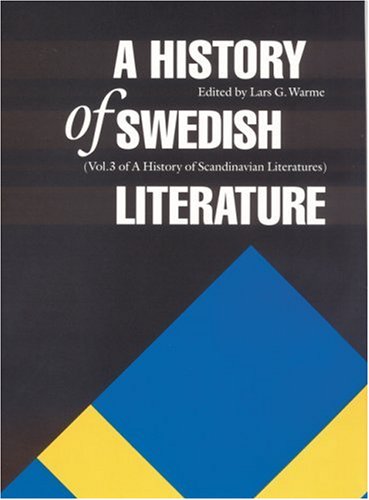
(Picture cover 'A History of Swedish Literature' copied from: http://ecx.images-amazon.com/images/I/41qIofc5%2BoL.jpg)
Foto 'Then svenska Argus' kopierad från: http://upload.wikimedia.org/wikipedia/commons/thumb/5/5e/Then_Sv%C3%A4nska_Argus.png/220px-Then_Sv%C3%A4nska_Argus.png)
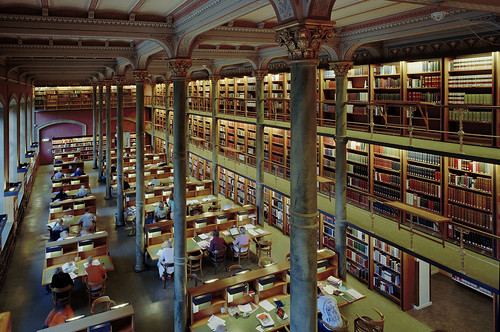
(Foto Kungliga biblioteket Stockholm, läsesalen kopierad från: http://farm5.static.flickr.com/4070/4698743229_7b191aa11d.jpg)