In Sweden, as in many other countries, the discussions around what is 'good' literature, music, film or any other form of cultural expressions is a recurrent debate.
During the spring and summer 2007 this discussion has been made topical again.
It started already before the general election last year when a representative for the liberal party proposed that Sweden should adopt a canon of literature.
This canon had to be put together by different representatives from both the cultural 'elite' and other citizens interested in 'good' Swedish literature.
This proposition also included ideas of some kind of national identity within literature and it became a hotly debated suggestion.
The government earlier this year decided to abolish the support to The Swedish Institute concerning translation of Swedish literature into other languages.
This specific economic support totalled the amount of 2 mllion kronors (222 000€ or 285 700$), a subsidy hardly ruining the Swedish economy.
Now the government suggest that the financial support for something called A book for all (En Bok för Alla) also should be abolished. This is an institution in Sweden with the aim to make Swedish and other literature known to a larger public.


Instead a new 'literature centre' is supposed to be created and in principle do the same job as The Swedish Institute, namely distribute money to foreign publishing houses showing interest in translating Swedish literature into other languages.
The Swedish Institute is going to promote international cultural exchange.
All this is surely fine but a problem with this idea could be that the work would be carried out by The Financing Institute of the Publishing Houses (my literate translation from Swedish Bokbranschens Finanseringsinstitut AB) a subsidiary to Svenska Förläggare Föreningen/'The Swedish Publisher's Association'.
This is a special interest group/-organization representing the big publishing houses and it was from this organization the idea for this literature centre came.
Concerning the economic support aimed at translating Swedish literature, the memorandum from the government states that:
"No difference between so called commercially negotiable book titles and what is not regardes as such" (my translation) should be made.
In this memorandum it is also said that an openness in this sense could lead to that foreign publishing houses would dare back up different kinds of authorship.
One problem is that if the above mentioned organization in Sweden is so tightly knit to the publishing houses and if it becomes their duty to distribute money for the translation of Swedish literature, it could lead to that foreign publishing houses only dare to risk money on the literature already being 'hot items'.
This would in turn lead to the same uniformity as we can see in Sweden at this very moment.
People do not seem interested in reading something intellectually challenging, they instead choose the more easy read literature - like 'easy listening'.
This might be acceptable if it's the first encounter with literature, leading to other readings of different kinds but unfortunately it seems as if all to many people continue reading the same type of literature over and over again.
Another problem concerning literature is that one can find good Swedish literature in other countries translated to the native language of this very country but at the same time not find the same literature in Sweden - in Swedish!
My fiancée and I thought this was very obvious when visiting Paris last year and the book-/music- and DVD-store FNAC (among others). At FNAC (and elsewhere) we could find a number of Swedish high quality literature in French, literature we had not found in Sweden, in Swedish!
When it comes to culture (in the forms of literature, music, film and other expressions) Sweden is extremely bad in promoting these different areas both within the country and outside it.
Through the Swedish Institute we promote the concept Sweden or the concept of certain Swedish cultural expressions but this is an image often 'smashed to pieces' when foreigners visit Sweden.
They think of Sweden as the country of August Strindberg, Selma Lagerlöf, Jussi Björling and Ingmar Bergman, the idea of the intellectually, culturally open-minded society - and it's not.
If we talk about IT, other technological areas and economy, Sweden has been much more succesful in promoting these sectors and that is because they generate more money in the short run but also more problems in the long run. These are also domains within society not having much problems applying for subsidies AND receiving them.
The 'money generating, consumerist factor' is more important than anything else for our politicians, decision makers and people in general.
This is very much due to the fact that the 'materialistic thinking' is more developed in Sweden than in many other comparable countries at the expense of our historic cultural heritage, in a wide perspective.
Sweden has, unfortunately, become a culturally undeveloped country.

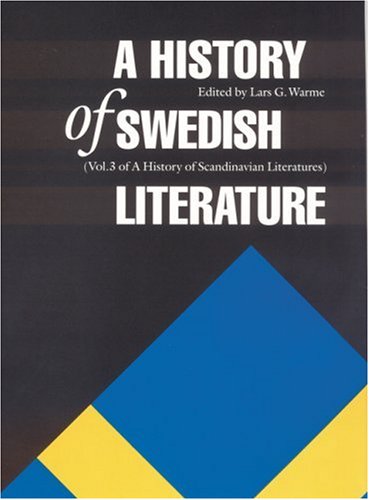
(Picture cover 'A History of Swedish Literature' copied from: http://ecx.images-amazon.com/images/I/41qIofc5%2BoL.jpg)
Foto 'Then svenska Argus' kopierad från: http://upload.wikimedia.org/wikipedia/commons/thumb/5/5e/Then_Sv%C3%A4nska_Argus.png/220px-Then_Sv%C3%A4nska_Argus.png)
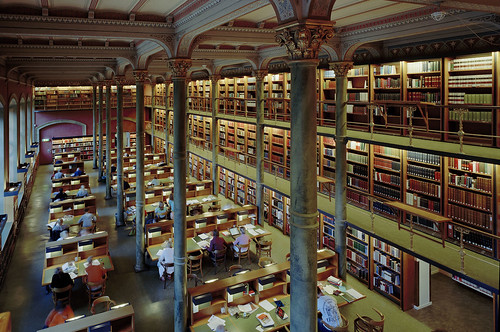
(Foto Kungliga biblioteket Stockholm, läsesalen kopierad från: http://farm5.static.flickr.com/4070/4698743229_7b191aa11d.jpg)
 Tomorrow, Wednesday 22 of August, is the last day for the Baltic Sea Festival.